Interesting Links for 27-03-2024
Mar. 27th, 2024 12:00 pm![[personal profile]](https://www.dreamwidth.org/img/silk/identity/user.png) andrewducker
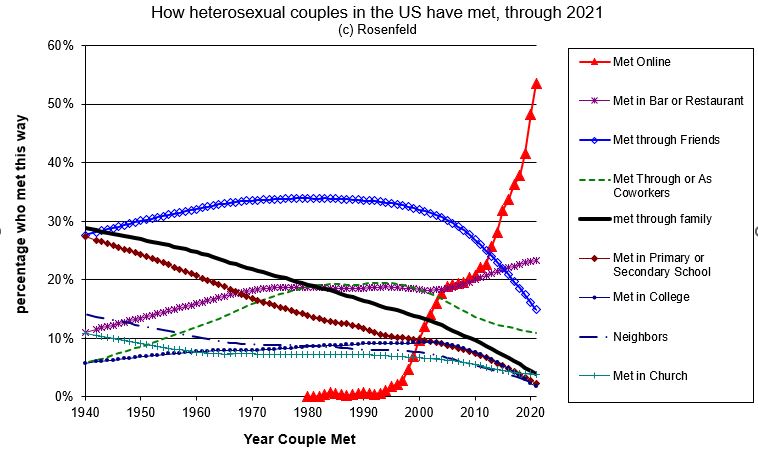
andrewducker- 1. How heterosexual couples in the USA meet
- (tags:dating relationships visualisation )
- 2. Shockingly, workers with job flexibility and security have better mental health
- (tags:work mentalhealth )
- 3. Things that don't work
- (tags:advice )
- 4. Chinese viewers debate Netflix's 'The Three-Body Problem;' cultural differences take center stage
- (tags:china netflix USA TV scifi writing culture )
- 5. BooksByMood - Find Books Based on Your Mood
- (tags:books emotion )
Tags:


no subject
Date: 2024-03-27 12:43 pm (UTC)We met by complete chance at the opera!
I wonder how many others meet by sheer chance?
no subject
Date: 2024-03-27 02:15 pm (UTC)I guess all meet by sheer chance. The graphs just show a breakdown of where that chance materialized. In my case, it was online.
no subject
Date: 2024-03-27 02:55 pm (UTC)no subject
Date: 2024-03-27 03:18 pm (UTC)And I think that "Wanting to be liked doesn't work" is mostly true if you throw yourself at it head-on. If it becomes obvious that you're doing things in order to be liked then this is not likely to end well.
If, on the other hand, you go looking for "What can I do to make myself more likeable", encounter the advice "Take a genuine interest in other people, listen to them openly, and be as genuine as possible while embracing the same in others." and put it into practice, then you will almost certainly be more liked than you were before.
Same as "Wanting to be happy doesn't work" - if you're constantly asking "But is this making me happy yet?" then you're very unlikely to be happy. If you look at the advice on what makes people happier, and make that your goal (while checking very occasionally that it's not making you actively unhappy) chances are that you'll find yourself happier in due course.
(Apologies if that makes little sense. Sleep bad.)
no subject
Date: 2024-03-27 04:00 pm (UTC)I agree with all this except the equation of “throw yourself at it head-on” with “if it becomes obvious… to be liked”. Two reasons: I don’t buy the implicit premise that throwing oneself at something head-on is inevitably obvious, and secondly I don’t think that obviously wanting to be liked is invariably unattractive, though I certainly agree that this often will be the case.
no subject
Date: 2024-03-27 04:44 pm (UTC)I'm pretty keen on being liked by both of the people on this thread and actually I hope that it is obvious that that is the case. But it's sincere and personally linked to the specific people - I want to be liked by my friends because I want to maintain a long-term mutual friendship and I want to be the sort of person who is likable and liked by specific people who I love and respect.
Bit different if the intention of the being liked is to score social points and if the target of the being liked by is just some person.
That being said, being charming or affable is a skill.
no subject
Date: 2024-03-27 05:19 pm (UTC)Hard disagree. I pretty much want to be liked by everyone and I see no moral hazard in this as a position. Judge the behaviour, not the motivation.
no subject
Date: 2024-03-27 05:50 pm (UTC)There's potentially two things going on. One is pursuing friendly relationships with people that one is not actually all that interested in and the other is making oneself likable to the general public.
I think it is likely that going about one's life (overtly) wanting to be liked by any Tom, Dick or Harry and (overtly) putting effort in to being likable for the sake of being liked is less likely to lead to long-term rewarding relationships and less likely to lead to the social rewards of being well-liked.
I don't think people mind other people being charming or affable or personable. I think they would rather other people were those things. But if someone who I know has a reputation for being generally charming is charming to me I might be charmed but I am less likely to feel that they and I have made an actual personal connection. In the same manner, if I engage with people who I don't actually want to have close relationship with in a way that makes me likeable to them what I've probably ended up with is a more hollow relationship than if I put that same energy in to a relationship where both parties were interested in the other person.
I definately understand the desire to be liked by a broad spectrum of people and therefore to spend effort making myself likable. There's a degree of self-protection in there for me. I suspect that for me, in my current life, it's a maladaptive artifact of my childhood.
I think the subtext of the original writer's point is that if someone spends their time and effort trying to get in with the cool kids when one doesn't actually like the cool kids that person is going to end up disappointed with their relationships and still not actually one of the cool kids.
Put another way, the sincerity of the desire for a specific connection is part of the behaviour.
I don't think the position I've taken above is necessarily universally true. I wish to do more drama so making myself more liked in the Edinburgh Am Dram scene is probably time well spent. Makes me easy to do business with.
no subject
Date: 2024-03-28 11:28 am (UTC)There's potentially two things going on. One is pursuing friendly relationships with people that one is not actually all that interested in and the other is making oneself likable to the general public.
Two very different use cases here. In the former there's a reasonable case to be made that costs will often (though not invariably) outweigh benefits, but I don't think that's what's under discussion here. It's a long way from the initial "wanting to be liked".
I think it is likely that going about one's life (overtly) wanting to be liked by any Tom, Dick or Harry and (overtly) putting effort in to being likable for the sake of being liked is less likely to lead to long-term rewarding relationships and less likely to lead to the social rewards of being well-liked.
Unclear whether this is intended to refer to the former or the latter of the use cases above. If the former then per above prob often true, but see above. If the latter then it's just a restatement of your original proposition. I think you're making up "long-term rewarding relationships" as a goal, which is again quite a long way from the original conversation, and I don't think you're adducing any evidence for your thesis that this is less likely to lead to the social rewards of being well-liked. "Overtly" is doing a lot of work here undefined; I am unsure that there is a clear and consistent definition of this as your statement implies.
I don't think people mind other people being charming or affable or personable. I think they would rather other people were those things. But if someone who I know has a reputation for being generally charming is charming to me I might be charmed but I am less likely to feel that they and I have made an actual personal connection. In the same manner, if I engage with people who I don't actually want to have close relationship with in a way that makes me likeable to them what I've probably ended up with is a more hollow relationship than if I put that same energy in to a relationship where both parties were interested in the other person.
This entire paragraph is about whether or not you are going to get something you want. It's predicated on the assumptions that (i) other people react like you and (ii) other people want what you want and (iii) most relevantly that the person whose goal is "to be liked by everyone" wants what you want. If that person's me (again not generalisable) then it absolutely isn't close relationships; it's warm and smooth transactions. If I had to generalise I'd punt that there is a relatively low correlation between "wanting close relationships" and "wanting to be liked by everyone", which in my observational experience has a significant negative component and is often far more about not wanting to be disliked than anything else, but I can't support that with anything more than anecdotal evidence.
I definitely understand the desire to be liked by a broad spectrum of people and therefore to spend effort making myself likable. There's a degree of self-protection in there for me. I suspect that for me, in my current life, it's a maladaptive artifact of my childhood.
I think this happens often but I don't buy that it's maladaptive in principle, though it may be in many instances. It's often very smart. Things go better when people like you. If you're trying to say "I act in a particular counterproductive way in order to be liked" or "I abandon my values in order to be liked" then that is different but (i) I don't think we can generalise from you to humanity and (ii) judge the behaviour and not the motivation.
I think the subtext of the original writer's point is that if someone spends their time and effort trying to get in with the cool kids when one doesn't actually like the cool kids that person is going to end up disappointed with their relationships and still not actually one of the cool kids.
Since the original writer wrote only "21. Wanting to be liked", you are inferring a great deal here.
Put another way, the sincerity of the desire for a specific connection is part of the behaviour.
No, it isn't. Motivation is never part of behaviour. Describe specific behaviours (which you have mostly not done here) and we can discuss.
I don't think the position I've taken above is necessarily universally true. I wish to do more drama so making myself more liked in the Edinburgh Am Dram scene is probably time well spent. Makes me easy to do business with.
Yes this is precisely my point and leaves me very confused about why you've written everything else in this comment.
no subject
Date: 2024-03-27 03:57 pm (UTC)no subject
Date: 2024-03-27 04:54 pm (UTC)I met my "platonic life partner" in 1999 on FriendFinder (at the time I don't think AdultFriendFinder was a thing, could be wrong, as I wasn't looking at that LOL).
We lived together 8 years as partners and now 16 as friends (WTF?)
I see we did that right as the "online" was starting to take off.
It's an interesting chart to see the decline of social circles being of import (circle of friends, church).
We consider ourselves queer, but haven't been in any homosexual relationships really (well she did go on a couple dates with a trans man once after we broke up (who I think was just in the early stages of realizing they were trans).
I did date an online friend (from Livejournal!) for a few years (that messed me up), and a long distance coworker (who REALLY was a bad idea, and boy. I sobered up after that).
no subject
Date: 2024-03-27 05:29 pm (UTC)no subject
Date: 2024-03-27 05:14 pm (UTC)3) Tree-based organization. Yeah, I file every e-mail relating to my editing job in a nest of Outlook folders, one each for every paper submitted to us, within larger folders for each issue of the journal. That way I can find things, and my co-editors, who rely on search terms, are always asking me for clarification help.
Written instructions. I don't follow them because they're wrong. Any complex instruction for doing something on a computer will bear no relation whatever to what you find when you try to do it. Any oral instruction for driving somewhere will contain "turn left" when is meant "turn right" or vice versa.
Video games. "You just start" my foot. Every time I've played a video game in the post-console era, which is about 3 times, I've stared at the screen in bafflement and had to ask, "So what do I do?" It's only intuitive if you already know, and I don't.
"Things that work: Dogs." It depends on what you want dogs to do. Scaring the sh*t out of innocent pedestrians who are just passing your house on the pavement, they're really good at that.
5) A word is missing from "Find Books Based on Your Mood." That word is "Self-help." "Find Self-help Books Based on Your Mood."
no subject
Date: 2024-03-28 07:12 am (UTC)no subject
Date: 2024-03-28 04:42 pm (UTC)no subject
Date: 2024-03-27 08:32 pm (UTC)no subject
Date: 2024-03-28 06:43 am (UTC)Yes. Not much makes me happy these days, but meeting a dog when I'm out for a walk never fails to be a point of light and happiness. Especially when the owner says: 'wow, normally she's really shy, but she ran straight over to you'.
Things that don't work: written instructions. Sob. Yes. Two examples in the last twenty-four hours. I wrote three bullet points with screen clippings of the 'press this, then that, then that' variety, and I don't think the recipient even looked at them. I'd even drawn red circles around the buttons that needed pressing!
Then a male manager said to me 'well, why didn't [very senior female manager x] tell us' and I bit my tongue because the latter had in fact told us, it was in the second line of her email marked urgent.
no subject
Date: 2024-03-28 07:18 am (UTC)no subject
Date: 2024-03-28 08:26 am (UTC)For context, the male manager is looking for work elsewhere, and the senior female manager is well-embedded in a (small-c-conservative) organisational hierarchy.
no subject
Date: 2024-03-28 10:43 am (UTC)I personally don't think a gentle statement of fact would be alienating. I guess if I were the female manager, such incidents would be "water off a duck's back" by now - but I'd enjoy a quiet chuckle that someone else noticed (and actually DID read the email!).