Some thoughts on mortgages and guarantors
Apr. 5th, 2021 11:00 am![[personal profile]](https://www.dreamwidth.org/img/silk/identity/user.png) andrewducker
andrewduckerI was reading this tweet, which basically says "I wish there was a way to crowdfund deposits, so I could buy rather than rent."
And I've slowly been coming round to the idea that while there is definitely an issue with there not being enough housing in the places where people want to live (as people have moved to the cities), there is also an issue that deposits scale with house prices, and monthly mortgage payments scale with mortgage payments _and_ interest rates.
This means that when interest rates drop the amount of mortgage a person can afford to repay goes up. And while it takes a while for things to adjust back and forth, it reverts back to somewhere around 1/3 of income.
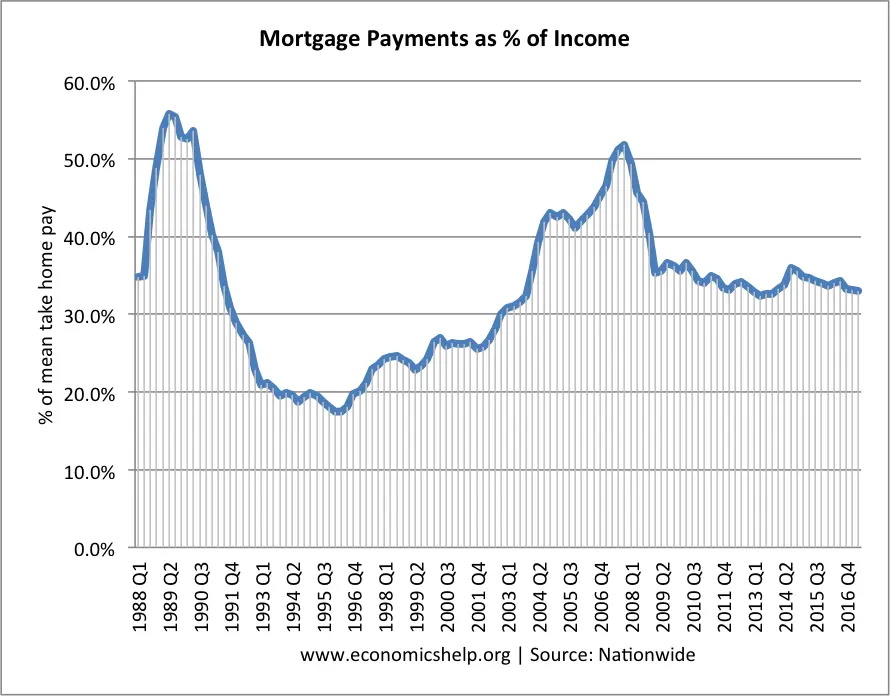
So if you're paying £1,000 per month (just to keep the numbers round) for 20 years then if interest rates are 1% you're able to borrow £217k, if they're 5% you're able to borrow £150k, and if they're at 8% then it's only £120k.
The problem is that if you need to get together a 10% deposit then now you need to raise £22k rather than £12k - the amount has nearly doubled. Interest rates dropping means that your deposit goes up dramatically, once house prices have gone up.
Now, those deposits are there for a reason. The bank is only willing to offer you such a low rate of interest because it can trust that it's a nice safe investment. Basically, that if you turn out to be unable to make the mortgage repayments then they can repossess the property and make their money back that way. But there are costs to repossession, they will want to make a quick sale, and they can't guarantee that house pricess will have remained high when you need to move. So they make you take the risk, by only lending you 90% of the price. That way falling house prices and repossession overheads can add up to 10% of the value of the house and they will _still_ get their money back.
But how often is that necessary? Could it be managed some other way?
A friend of mine moved a while back, and needed someone to guarantee that their rent would be paid. So I, trusting that they would do their best to pay their rent, acted as a guarantor. I didn't have to fork over any cash up front, but I did have to sign something saying that if they didn't pay then I'd step in to cover things.
Would that model work for mortgages? Could ten of us club together and act as co-guarantors for a mortgage, so that if things went wrong they would be fine? You'd have to do that for long enough for the value of the property to go up by 10%, which would vary dramatically by location. And you'd want to make sure that people weren't guaranteeing more possible disasters than they were good for. But I don't see it as being unworkable.
Thoughts? (This is not my specialist area. And I have no influence over how banks operate. I'm just curious if this model would work, or if I'm missing something obvious.)
(I don't think that owning property is for everyone. If your boiler breaks then it's your responsibility. If your pipes burst then likewise. You need buildings insurance. And you almost certainly want to be sure you'll be living somewhere for at least 5 years or the costs aren't worthwhile. But I know people who are putting as much money into rent as they would into a mortgage (or more), but have no way of switching over to something that would actually be *theirs* at the end of the process because deposits are just huge.)
And I've slowly been coming round to the idea that while there is definitely an issue with there not being enough housing in the places where people want to live (as people have moved to the cities), there is also an issue that deposits scale with house prices, and monthly mortgage payments scale with mortgage payments _and_ interest rates.
This means that when interest rates drop the amount of mortgage a person can afford to repay goes up. And while it takes a while for things to adjust back and forth, it reverts back to somewhere around 1/3 of income.
So if you're paying £1,000 per month (just to keep the numbers round) for 20 years then if interest rates are 1% you're able to borrow £217k, if they're 5% you're able to borrow £150k, and if they're at 8% then it's only £120k.
The problem is that if you need to get together a 10% deposit then now you need to raise £22k rather than £12k - the amount has nearly doubled. Interest rates dropping means that your deposit goes up dramatically, once house prices have gone up.
Now, those deposits are there for a reason. The bank is only willing to offer you such a low rate of interest because it can trust that it's a nice safe investment. Basically, that if you turn out to be unable to make the mortgage repayments then they can repossess the property and make their money back that way. But there are costs to repossession, they will want to make a quick sale, and they can't guarantee that house pricess will have remained high when you need to move. So they make you take the risk, by only lending you 90% of the price. That way falling house prices and repossession overheads can add up to 10% of the value of the house and they will _still_ get their money back.
But how often is that necessary? Could it be managed some other way?
A friend of mine moved a while back, and needed someone to guarantee that their rent would be paid. So I, trusting that they would do their best to pay their rent, acted as a guarantor. I didn't have to fork over any cash up front, but I did have to sign something saying that if they didn't pay then I'd step in to cover things.
Would that model work for mortgages? Could ten of us club together and act as co-guarantors for a mortgage, so that if things went wrong they would be fine? You'd have to do that for long enough for the value of the property to go up by 10%, which would vary dramatically by location. And you'd want to make sure that people weren't guaranteeing more possible disasters than they were good for. But I don't see it as being unworkable.
Thoughts? (This is not my specialist area. And I have no influence over how banks operate. I'm just curious if this model would work, or if I'm missing something obvious.)
(I don't think that owning property is for everyone. If your boiler breaks then it's your responsibility. If your pipes burst then likewise. You need buildings insurance. And you almost certainly want to be sure you'll be living somewhere for at least 5 years or the costs aren't worthwhile. But I know people who are putting as much money into rent as they would into a mortgage (or more), but have no way of switching over to something that would actually be *theirs* at the end of the process because deposits are just huge.)


no subject
Date: 2021-04-05 10:40 am (UTC)You're basically proposing starting a building society that offers 100% mortgages. The detail that someone else is underwriting the bulk of the sum while you stump up the deposit does not much affect the entire picture of the package as a whole - except it then becomes less attractive for you than a building society would be, since you propose becoming a guarantor - taking on the risk of default - while letting the actual underwriter keep all the interest, which is the thing a building society normally spreads between many customers to ideally profit as a whole but at least cover the risk of default.
My first thought here has to be - you'd be taking on risk, and calculating whether to take risk and how to price it is pretty much what the bank *does*. If there was money lying on the ground - or even a strong likelihood of breaking even - they would be eager to pick it up; arguably too eager, as the subprime mortgage crisis demonstrated. Before the crisis, 100% mortgages - no deposit - for first time buyers were widely available. After, they no longer were, and after all this time they still no longer are. This to me suggests the consensus is that, on balance, the scheme could not be made break even.
It may be that banks have been burned too much and are too cautious in their assessment; nonetheless, I would consider at least pricing some interest into the scheme.
Also, the second you switch from doing this privately for friends to offering this to the general public, everything becomes heavily regulated, though I don't know the details off the top of my head.
no subject
Date: 2021-04-05 10:43 am (UTC)(Banks backed off on low deposit mortgages at least partially because regulators told them to)
no subject
Date: 2021-04-05 10:51 am (UTC)no subject
Date: 2021-04-05 10:52 am (UTC)But for many of these people the monthly payments are totally affordable. They just can't afford to *also* save up that much cash in addition.
no subject
Date: 2021-04-05 11:14 am (UTC)This is a terrible situation to be in and people should not be in that situation, but this is the sort of calculation the lender has to consider.
(edit: the thing I find most broken in all this is the bit where, after you've demonstrated your ability to create a financial cushion, the lender then makes you spend that cushion and start over...)
no subject
Date: 2021-04-05 11:18 am (UTC)He went to another bank for the money, but it still shows a very high degree of risk aversion.
no subject
Date: 2021-04-05 11:19 am (UTC)no subject
Date: 2021-04-05 11:27 am (UTC)no subject
Date: 2021-04-05 11:37 am (UTC)no subject
Date: 2021-04-05 11:39 am (UTC)If you don't have enough spare cash to deal with your boiler imploding then house ownership is probably not for you.
no subject
Date: 2021-04-05 12:02 pm (UTC)I realised the scam in time: they do that, and you buy the Glorious Flat, and then in three years' time the fixed rate expires and they say oh dear there are no more fixed rates available for 14x salary loans, we are moving you onto the standard 12%, which you can't pay. So they repossess and then they have your substantial deposit and you have no flat.
I suspect the lenders who would accept guarantees from rich friends are differentially the lenders who would screw you over in the future. At which point you lose the house and the friends, because nobody likes discovering they're on the hook for tens of thousands in underwater mortgage.
no subject
Date: 2021-04-05 12:30 pm (UTC)As an aside my boiler asploaded (well, gave up) and we had to pay. We paid. We got a boiler. I have NEVER heard of a landlord being so prompt, and in a pandemic. Also, in ~4 years we will never again need to pay rent; which is I think the main win from buying. Because of course rich folks lives cost less, which is totally fair. uhuh.
no subject
Date: 2021-04-05 12:32 pm (UTC)You and your colleagues are taking on the risk of non-payment, either individual or systemic, but not taking on the reward.
So I think there are perhaps two approaches.
You could try and set up a building society or credit union or some other form of investment co-op. (1)
You could set up a micro-loan web site to help people crowd-source a deposit (2)
I suspect that house prices falling 10% is more common than you might think and also systemic. If the a big factory closes in Town A, then *all* of the house in Town A go down in value at exactly the same time as lots of the workers in Town A lose their income.
Regulation is going to be a thing here because one of the great problems with the world is that bankers are a) stupider than they ought to be and b) happier to stick risk on other people then they ought to be and so there is a lot of regulation going on.
(1) & (2) thinking about how this micro-finance platform might work. Say I was prepared to put in £100 to help a relative stranger get the deposit on a house. The average house price in Scotland is £165k, 10% deposit is £17k. You would need 170 people to put in £100 to help one person access a deposit. I think there are some problems with interest rates on this loan. If you're interest rate is approaching the standard mortgage interest rate you essentially have 100% mortgage in two parts.Significantly below the current mortgage rate and it's free money.
You could try structuring this a bullet loan. 200 of us put in £100 for a strangers deposit. When they either sell the house or re-mortgage we all get £200 back. Or you could structure it as an equity investment. We put in 10% of the purchase price. When they house is sold we get 10% of the sales price.
Setting up a building society sounds less complex but bigger The model already exists.
If we all decide to put £100 a month in savings in to the buildings society we need 1,650 members in order to be able to fund the purchase of 1 house a month. With a vigorish of 0.5% (2.5% mortgage interest rate vs 2.0% interest paid to savers) that gives you about £70 a month per house for all other costs. So you need either 42 months or 70,000 savers before you can hire your first cheap employee.
There are some other benefits beyond a savings platform that might be interesting. You could use the building society as a form of social engineering. For example loans are only available to public sector worker or loans are only available to people who will sign a covenant agreeing to make anyone they sell the house to also sign a covenant not to run an AirBnB.
no subject
Date: 2021-04-05 12:34 pm (UTC)no subject
Date: 2021-04-05 12:39 pm (UTC)no subject
Date: 2021-04-05 12:40 pm (UTC)But the simple one of "me and a few friends want to help our mutual friend Bob" should be a fair bit simpler!
no subject
Date: 2021-04-05 12:41 pm (UTC)no subject
Date: 2021-04-05 12:46 pm (UTC)But as a thought experiment, imagine Amazon's employment practices if everyone who might work at Amazon already owned 100% of the equity in a suitable home.
It's a universal basic income of the mortgage payment each month.
no subject
Date: 2021-04-05 12:50 pm (UTC)no subject
Date: 2021-04-05 12:58 pm (UTC)But I think the larger the sums of money involved and / or the number of people involved the more complex it becomes. Particularly as you're less able to rely on the space between handshakes.
10 people sticking in £2k sounds like a really awkward proposition. For most people £2k is too large a sum to just shrug off so it needs some sort of guarantee. 10 people is enough people that circumstances could change significantly. What happens if three of the funders suffer a reduction in their circumstances so that £2k becomes much, much important to them but conversely 3 people do very well and become less fussed about when the £2k is paid back.
If the deal is, say, we all get our money back when 6 out of 10 of us vote to get our money back and only one of use really, really needs the money right now that's awkward. Or what happens if I keep signing up to guarantor agreements for other people and it becomes apparent that I'm not actually able to guarantee all of those people. Or I go bust and my creditors want to know what Bob's friends are going to do to get my share of the money back from Bob.
And as soon as you start having to write down what happens when things become complex then the documents become complex. And you need to make sure that people understand what this means.
What might work as a platform is Person A requires a deposit and / or guarantee. Person B provides the guarantee to their friend or relative Person A and the platform allows the community to put in smaller amounts guaranteed by Person B.
no subject
Date: 2021-04-05 01:02 pm (UTC)no subject
Date: 2021-04-05 01:03 pm (UTC)How on earth do you achieve that?
no subject
Date: 2021-04-05 01:05 pm (UTC)"I didn't have to fork over any cash up front, but I did have to sign something saying that if they didn't pay then I'd step in to cover things."
I agree that guaranteeing multiple things would be tricky. That's what I said "And you'd want to make sure that people weren't guaranteeing more possible disasters than they were good for." - but you could do that with a registry of guarantors that lenders have access to.
no subject
Date: 2021-04-05 01:06 pm (UTC)no subject
Date: 2021-04-05 01:08 pm (UTC)Current owner occupier rates about 2/3rd of the UK population. When all of those people have paid off their mortgages someone inherits a bunch of houses mortgage free.